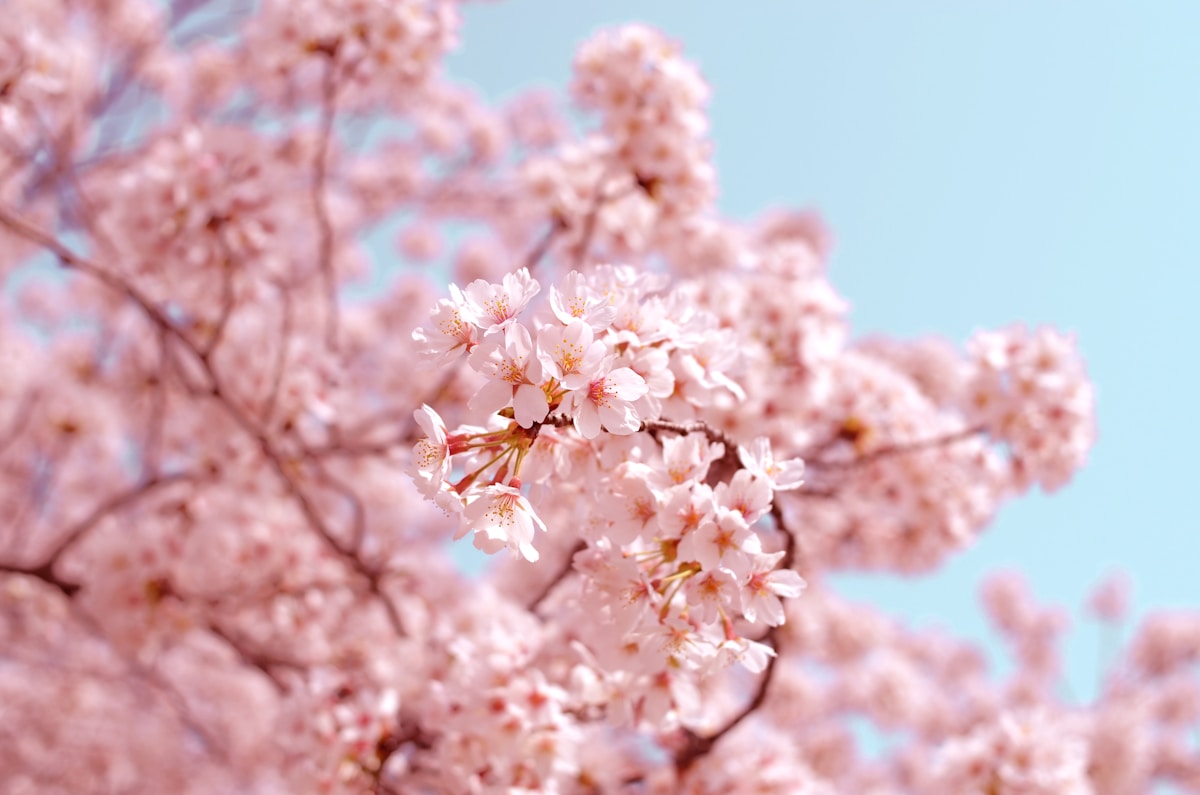
Korea’s cherry blossom season lasts roughly two weeks. In a good year, the petals hold through the second week of April. In a warm year — or after a late cold snap — the window narrows further. The blossoms don’t negotiate, and neither do the crowds that arrive to see them. Yeouido on a peak weekend afternoon in April is one of the most densely packed public spaces you will encounter outside of a concert venue.
None of this is a reason to avoid it. Cherry blossom season in Korea is genuinely one of the most beautiful things the country produces, and if you’re here in spring, you should engage with it fully. The goal of this guide is to help you do that smartly — to know which spots are worth the crowds, which ones offer the same spectacle with half the people, and how to time your visit to actually enjoy it rather than just survive it.
When the Blossoms Peak
Korea’s cherry blossom front moves northward from late March through mid-April, following rising temperatures up the peninsula. Jeju Island blooms first — typically in the last week of March. Busan and the southern coast follow in early April. Seoul usually peaks around April 7–12, and cities further north (Chuncheon, Sokcho) bloom a few days later still.
2026 bloom forecast by region:
- Jeju Island — March 25–30
- Jinhae / Busan — April 3–8
- Seoul / Gyeongju — April 7–12
- Chuncheon / Sokcho — April 10–15
These dates are forecasts. A warm February can push peak bloom forward by five days; a cold snap can delay it or cause petals to drop early after opening. The Korea Meteorological Administration publishes rolling bloom forecasts from late February — worth checking the week before you travel. The trees themselves are the most reliable indicator: look for the moment when roughly 80% of flowers on a tree are open (manggae, 만개), which is peak.
Plan to be in Korea during the window, not just passing through it. Two or three days in Seoul at peak bloom is a qualitatively different experience than a brief stop.
In Seoul
Yeouido Spring Flower Festival (여의도 봄꽃축제)
Yeouido is Seoul’s answer to the question of what happens when you plant rows of cherry trees along a wide riverside promenade and wait thirty years. The Yunjung-ro boulevard that runs through Yeouido park and along the Han River is lined on both sides with mature Yoshino cherry trees — the result is a continuous tunnel of white-pink blossom stretching for over a kilometre, and the effect, when the trees are fully open, is extraordinary.
The Yeouido Spring Flower Festival runs for approximately ten days during peak bloom, with stages, food stalls, and evening light installations along the boulevard. Crowds on weekend afternoons are very large — think shoulder-to-shoulder on the main promenade by noon. The practical advice is simple: go before 09:00 or after 18:30. Early morning gives you the trees and the river with almost no one there. Evening light gives you the lanterns and a cooler atmosphere, with the trees illuminated against the Han River skyline.
The nearest metro station is Yeouinaru (Line 5, Exit 2) or Yeouido (Lines 5 and 9, Exit 3). The boulevard begins immediately from both exits.
68 Yeouigongwon-ro, Yeongdeungpo-gu
Kakao Map · Naver Map
Seokchon Lake (석촌호수)
Seokchon Lake in Songpa-gu is Seoul’s most visually distinctive cherry blossom location — and the one most likely to appear in your social feed before you ever arrive. The lake is ringed by cherry trees, and from the right angle on the eastern bank, you get the blossoms reflected in the water with Lotte World Tower — the fifth-tallest building in the world — rising behind them. It’s a genuinely remarkable composition and one that requires no special effort to find: just walk the lake perimeter and the angles present themselves.
The lake is divided into east and west sections by Olympic-ro road. The east lake (동호) is the one with the Lotte World Tower views and the denser tree lining. The west lake (서호) is slightly quieter. Both are walkable in under 30 minutes. The area around the lake has good cafés — Songpa-gu has invested heavily in the streetscape here, and it shows.
Crowds are serious on weekends but more manageable than Yeouido because the lake circuit distributes people naturally rather than funnelling them down a single boulevard.
Seokchon-dong, Songpa-gu
Kakao Map · Naver Map
Gyeongbokgung Palace (경복궁)
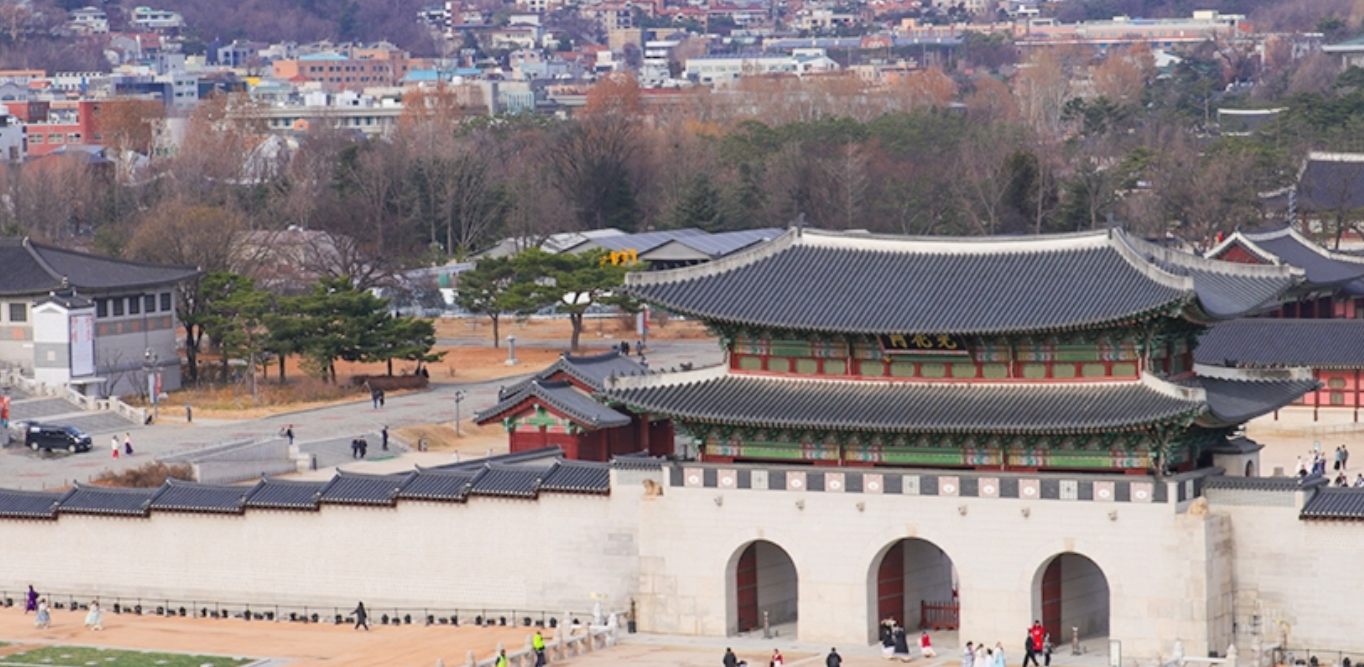
Cherry blossom season and Gyeongbokgung Palace make natural companions — the palace’s traditional architecture of tiled roofs and painted eaves frames the blossoms in a way that feels historic rather than festive. The trees are concentrated along the inner courtyards and the paths leading between the main palace buildings, and the combination of blossoms with the mountain backdrop of Bugaksan behind the palace is one of the defining images of Seoul in spring.
The practical advantage of Gyeongbokgung over Yeouido is pacing: the palace has multiple sections and a natural circuit, which means crowds distribute themselves more evenly. Arrive at opening (09:00) or in the last hour before closing for the best balance of light and manageable crowds. Wearing hanbok (한복, traditional Korean dress) — available to rent from numerous shops near the Gyeongbokgung entrance — grants free palace admission, and you’ll see plenty of visitors doing exactly this during blossom season.
The National Folk Museum of Korea sits inside the palace grounds and is free — a useful shelter if spring rain arrives, which it sometimes does during blossom season.
For more on the palace and the surrounding Gwanghwamun area, see the Gwanghwamun guide.
09:00–18:00 (extended hours in summer)
161 Sajik-ro, Jongno-gu · Gyeongbokgung Station, Line 3, Exit 5
Kakao Map · Naver Map
Namsan Park (남산공원)
Namsan — the forested hill at Seoul’s centre, topped by N Seoul Tower — offers a different kind of cherry blossom experience: one where the trees are spread through a park on a hillside, with views opening out across the city as you climb. The approach roads and footpaths up Namsan are lined with cherry trees, and the combination of elevated perspective and less concentrated crowds makes it a good alternative to the busier river-level spots.
The easiest route is the cable car from Myeongdong, which deposits you near the tower with views in every direction. From there, walk downhill through the park back toward Itaewon or Namsangol — the descent passes through the densest tree sections and takes about 40 minutes at a relaxed pace. The lock-covered fencing near the tower is unavoidable, but the park paths below it are pleasant.
Namsan rewards an afternoon visit during blossom season: the light on the trees from the south-facing slopes in the late afternoon is notably warm, and the city views from the tower with blossoms in the foreground photograph well.
Open 24 hours · Myeongdong Station, Line 4, Exit 3 (cable car base)
Kakao Map · Naver Map
Outside Seoul
Jinhae Gunhangje (진해 군항제)
If you visit Korea during blossom season and only go to Seoul, you will have seen a lot of cherry trees. But you will not have seen anything on the scale of Jinhae.
The Gunhangje Festival in Jinhae — a port city in South Gyeongsang Province, now part of Changwon — is the largest cherry blossom festival in Korea. The city plants over 360,000 cherry trees along its streets, waterways, and hillsides, and for ten days in early April the entire city transforms. The festival draws millions of visitors annually. It is, by any measure, overwhelming — and worth going.
The image most associated with Jinhae is Gyeonghwa Station (경화역) — a small, no-longer-operating train station where cherry trees line both sides of a decommissioned track, the branches arching overhead to form a complete tunnel of blossoms. Petals fall continuously. It looks like a film set. It is real, and every person who visits it photographs it, which means you should arrive by 07:30 if you want the shot without several hundred strangers in it.
Beyond Gyeonghwa Station, the Yeojwacheon Stream (여좌천) running through the city centre is lined with cherry trees and lit at night, and the surrounding hillside roads have long straight avenues of mature trees. The festival runs with a full programme of military band performances, cultural events, and night illuminations.
Getting to Jinhae from Seoul: Take the KTX to Masan Station (approximately 2 hours 40 minutes, ₩47,800) then a local bus or taxi to Jinhae — total journey around 3.5 hours. From Busan, the journey is under an hour by bus. Jinhae warrants an overnight stay during festival period; day-trippers from Busan are very common.
Gyeonghwa-dong, Jinhae-gu, Changwon
Kakao Map · Naver Map
Yeojwa-dong, Jinhae-gu, Changwon
Kakao Map · Naver Map
Gyeongju (경주)
For visitors who want cherry blossoms without the Yeouido-scale crowds, Gyeongju is the answer. Korea’s ancient Silla Kingdom capital — 55 minutes from Busan by KTX — has cherry trees planted throughout the historic district, and the combination of blossoms with the great burial mounds of Daereungwon (대릉원, the Tumuli Park) is one of the more unusual and beautiful things you can see in Korea in spring: grass-covered royal tombs, some 23 metres high, ringed by flowering cherry trees against the Gyeongju hills.
Bomun Lake (보문호) on the eastern edge of the city has a longer cherry blossom promenade with fewer crowds than anything in Seoul, and the Gyeongju National Museum nearby has cherry trees in its courtyard that bloom slightly later than the city centre. The whole of historic Gyeongju is walkable or cyclable — bicycle rental is cheap and widely available near the Tumuli Park.
Gyeongju pairs naturally with a Busan trip — the two cities are close enough to combine without difficulty, and Gyeongju’s Bulguksa Temple adds a second full day of content beyond the blossoms.
9 Gyerim-ro, Gyeongju
Kakao Map · Naver Map
San 5, Bomun-ro, Gyeongju
Kakao Map · Naver Map
Practical Tips
Timing within the day. Yeouido and Seokchon Lake are most crowded between 11:00 and 17:00 on weekends. Arrive before 09:00, or return after 18:30 when light is softer and numbers drop significantly. Weekday mornings are dramatically quieter than weekends at every location.
Rain is not a disaster. Cherry blossoms in rain are a specific aesthetic that Koreans have a word for — hana-mi (꽃비, kkotbi, meaning “flower rain”) describes petals falling in wet conditions. A light shower during peak bloom produces floating petals on water surfaces and empty promenades. Bring a compact umbrella, not a poncho.
Petals fall fast. Once a warm day reaches 20°C+ after full bloom, petals begin dropping within 24–48 hours. A strong rain event or wind can end the season overnight. Check forecasts daily during your visit.
What to bring. Light layers — April mornings in Seoul can still be 10°C, afternoons warm to 18–20°C. Comfortable walking shoes. A portable battery for your phone. Cash for street food stalls at festival sites (many vendors don’t take card).
Accommodation. Book hotel and guesthouse accommodation in Seoul 4–6 weeks in advance if you’re visiting during peak blossom week (first week of April). Prices increase significantly. For Jinhae festival period, book even earlier — accommodation in the city itself sells out months ahead; staying in Busan and day-tripping is the practical alternative.
Bloom forecast resources. The Korea Tourism Organisation website publishes annual bloom calendars, and local media (search “벚꽃 개화 예측 2026”) provide rolling updates as the season approaches.
Cherry blossom season is the one time of year when Korea’s cities are visibly, unashamedly beautiful in a way that surprises even people who live there. The crowds are real and the window is narrow, but the experience of standing under a fully-open cherry tree in morning light — petals coming down slowly, the air still cold enough to see your breath — is one that tends to stay with you.
For help planning the rest of your spring trip, see The Best Months to Visit Korea and the Seoul First-Timer’s Guide.