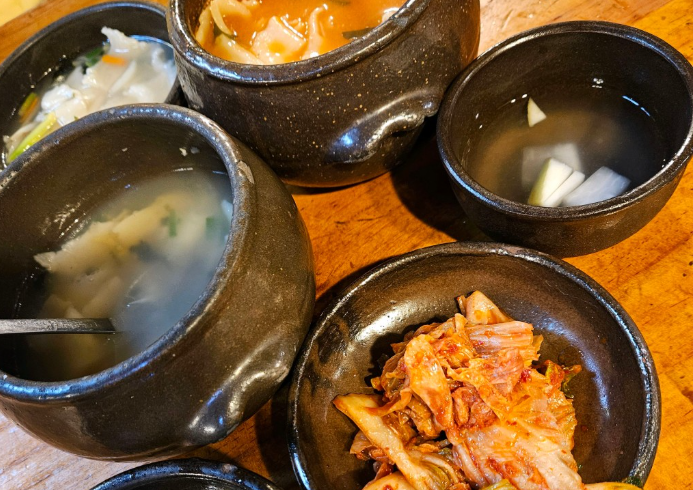
If Korean food has a dish that feels like a warm hug, it’s sujebi (수제비). Hand-torn pieces of wheat dough slowly simmered in a clear, savoury broth until they puff up and turn silky — this is the kind of food Koreans grow up eating on rainy days, after school, and whenever life calls for something simple and restorative.
It’s not glamorous. It doesn’t photograph like bibimbap or command the same global recognition as Korean BBQ. But ask any Korean what they crave when they’re tired or cold, and sujebi will come up almost every time.
For other great comfort food experiences in Seoul, see our Korean street food guide.
What Is Sujebi?
Sujebi (수제비) translates literally as “hand (su, 手) + torn (jebi).” The dish is exactly what the name describes: pieces of dough — made simply from wheat flour, water, and a little salt — torn by hand directly into a simmering pot of broth.
Unlike pasta or noodles, sujebi has no fixed shape. Each piece is different depending on how it’s torn, which gives the dish its characteristic rustic charm. The torn edges become slightly ruffled as they cook, creating texture that holds onto the broth beautifully.
The Broth
The foundation of sujebi is almost always anchovy and kelp broth (멸치 다시마 육수), which gives the soup its clean, mineral savouriness without heaviness. Some versions use a richer dashima (kelp) broth alone, or add dried shrimp for depth. The broth is deliberately restrained — the point is clarity, not complexity.
Additions and Variations
The standard sujebi includes:
- Zucchini (애호박) — sliced into thin half-moons, it softens into the broth gently
- Potato (감자) — chunks that thicken the broth slightly as they cook
- Dried anchovies — sometimes added whole to intensify the base
- Egg — cracked in near the end and stirred through in ribbons
Regional and restaurant variations go further. 들깨 수제비 (deulkkae sujebi) stirs in ground perilla seeds, which turn the broth a pale ivory and add an earthy, nutty depth. Seafood versions incorporate clams, oysters, or small shrimp. Some versions add kimchi for heat and tang.
Sujebi vs. Kalguksu
These two dishes are often confused — and often served together. The difference is simple: kalguksu (칼국수) uses knife-cut noodles (kal = knife), while sujebi uses hand-torn dough pieces. Many restaurants offer both. The broth and garnishes are nearly identical; it’s purely about the texture and shape of the dough.
Why Sujebi Matters
Sujebi has deep roots in Korean food history. During the Korean War and the lean decades that followed, wheat flour — distributed through US aid programmes — became a staple for many families who couldn’t afford rice. Sujebi was survival food: cheap, filling, and endlessly adaptable.
That history is embedded in how Koreans feel about the dish today. Sujebi carries an emotional weight that goes beyond flavour — it’s associated with grandmothers, with difficult times overcome, with the comfort of family kitchens. In Korean, the phrase “할머니 손맛” (halmoni sonmat, grandmother’s hand flavour) is used for food that tastes like it was made with care and time. Sujebi is the definition of sonmat cooking.
Where to Eat It: Insadong Hangari Sujebi (인사동 항아리 수제비)
Tucked into a narrow alley behind Ssamziegil in Insadong, 인사동 항아리 수제비 (Insadong Hangari Sujebi) is one of Seoul’s most beloved sujebi restaurants — and one of the most enduring. It has been run by the same family for over 33 years, now into its third generation.
The name hangari (항아리) means earthenware jar, and the interior makes the reference clear: one full wall is lined floor-to-ceiling with traditional onggi pottery vessels, the same dark glazed jars used for centuries to ferment kimchi and doenjang. Wooden tones, low light, and the smell of broth simmering away give the place an atmosphere that feels genuinely old Seoul — unhurried, unpretentious, and warm.
The restaurant gained wider recognition after being featured on the popular Korean TV programme 맛있는 녀석들 (Delicious Guys) in 2023, but regulars have known about it for decades.
What to Order
수제비 (Sujebi) — ₩9,000 The classic. Thick, chewy torn dough in a clear anchovy broth with zucchini and potato. The texture is the star — slightly elastic with ruffled edges that soak up every drop of broth.
들깨 수제비 (Perilla Sujebi) — ₩10,000 Ground perilla seeds stirred into the broth, turning it pale and nutty. A richer, earthier experience than the original. Worth trying if you’ve never had deulkkae before.
해물파전 (Seafood Pancake) — ₩15,000 Crisp, egg-forward pajeon with seafood. An excellent pairing with the soup and a cold glass of 동동주 (dongdongju) — the house rice wine that comes floating with small grains of rice on the surface.
Practical Information
Address: 서울 종로구 인사동8길 14-1 (Seoul, Jongno-gu, Insadong 8-gil 14-1)
Getting there: Anguk Station (Line 3), Exit 6. Walk toward Insadong and pass Ssamziegil — look for the alley on the right after the pharmacy (수도약국). The bright yellow sign at the end of the alley is hard to miss.
Hours: 11:30am–8:50pm daily Break time: weekdays 3:30–5:00pm / weekends 4:00–5:00pm
Price range: ₩9,000–₩15,000 per dish
Tips:
- Arrive before noon on weekends — queues of four or five groups can build up quickly.
- You can choose to sit Korean-style on floor cushions or at standard tables. The floor seating adds to the atmosphere.
- Sujebi travels well — leftovers reheat beautifully with a splash of water to loosen the broth.
Sujebi doesn’t need much to be good. Flour, water, broth, and time. At its best — and at Insadong Hangari Sujebi, it is at its best — it’s proof that Korean comfort food needs no embellishment.