Korea has a deep, almost philosophical relationship with eating in season. Ask any Korean home cook what fish to eat in spring and they won’t give you a vague answer — they’ll tell you gangdodari [flathead flounder], they’ll mention that the bangeojul [yellowtail season] is wrapping up, and they’ll probably tell you exactly which market to visit. That precision, that insistence on eating things at the right moment, is baked into the way Koreans think about food. And nowhere in Seoul does it run deeper than at Noryangjin Susanshijang [Noryangjin Fish Market].
This is not a place that bothers with ambiance. It is fluorescent-lit, loud with the sound of water tanks and rapid Korean, and alive at hours when most of the city is asleep. It is also, for raw seafood, one of the most serious places on the peninsula. Which is what makes what Cheongyang Seafood is doing inside it — a quietly excellent omakase course built entirely around what’s swimming fresh that week — so worth your attention.
Inside Korea’s Most Legendary Fish Market
Noryangjin Fish Market (노량진수산시장) has been operating on the south bank of the Han River since 1927. The current building — a sprawling, industrial complex in Dongjak-gu — handles thousands of tonnes of seafood every year, supplying restaurants across Seoul and serving as one of the city’s most visited food destinations for those who know where to look.
It is most famous for its live seafood wholesale floors, where buyers from restaurants, hotels, and caterers arrive in the small hours to bid on the freshest catches. But the ground floor is also home to dozens of retail stalls selling live fish, shellfish, sea cucumbers, abalone, and anything else that came off a boat recently — all maintained in tanks and sold by the kilogram or by the portion, to be sliced into hoe [raw fish sashimi] on the spot.
Getting there is straightforward. Take Seoul Metro Line 1 or Line 9 to Noryangjin Station and exit through Exit 9. From there, walk past the car park in the direction of the football pitch — the market entrance is less than five minutes on foot, unmistakable once you spot the signage and catch the first whiff of salt water and crushed ice.
The market operates around the clock. 3am or 3pm, it doesn’t matter — the tanks are full, the vendors are working, and the fish is the same freshness regardless of when you arrive.
Finding Cheongyang Seafood (청양수산)
There are a lot of stalls inside Noryangjin. Navigating them on a first visit can feel overwhelming — rows of tanks, vendors calling out, identical-looking signs. The trick is to know what you’re looking for before you walk in.
Cheongyang Seafood (청양수산), trading as Stall 40 (활어 40호) in the live fish section on the first floor, is positioned in the innermost part of the market, closest to South Gate 1 (남1문). It’s not the first stall you’ll pass — head in, go deep, and look for the distinctive double row of tanks and the hand-written pricing boards in both Korean and figures.
What sets Cheongyang apart, even visually, is the quality of the tanks. The water is clear, the fish are active, and the variety is notable — on a typical visit you’ll find not just the obvious gwangeo [flatfish] and yeoneo [salmon], but gamseongdom [black sea bream], chamdom [red sea bream], neungseongeoh [grouper], and whatever is riding the seasonal peak that week. In late winter and early spring, expect to see bangeoh [yellowtail/amberjack] being phased out and gangdodari [flathead flounder] and jeonjaengi [jack mackerel] front and centre.
For those who prefer to plan, Cheongyang Seafood can also be reached and ordered through the 인어교주해적단 app (a popular Korean platform for fresh seafood ordering), which allows you to browse the current offerings remotely. That said, reserving by phone is also easy and recommended — especially if you’re planning an omakase visit.
Phone: 010-8979-7618
The Omakase Course: ₩85,000 for the Season on a Plate
Omakase is a Japanese word — “I leave it to you” — but in Korea it has taken on a life of its own. At high-end Korean seafood restaurants, an omakase course might mean 15 courses, a private room, and a bill that runs well past ₩200,000 per person. At Cheongyang Seafood, it means something different and, depending on your values around food, more interesting: you tell the vendor your party size and budget, they go to the tanks, and twenty minutes later you have a platter of everything that’s worth eating right now, sliced to the right thickness, assembled with the kind of quiet expertise that only comes from doing this every day for years.
The baseline price for the omakase course is ₩85,000 for a small portion (소짜리), which is well-calibrated for two people eating as a meal with drinks, or a couple eating generously alone. Larger portions scale accordingly — it’s worth discussing with the vendor when you book.
The experience of ordering an omakase here also includes a small theatrical pleasure. Call ahead, explain what you want, arrive at the agreed time, and watch as the vendor — typically working behind the counter at speed — picks fish from the tanks and fillets them in view. The fish you’re eating were alive within the hour. This is hoe [Korean raw fish] at its most direct, and it is a fundamentally different experience from eating sashimi that arrived pre-portioned in a refrigerated case.
Ask the vendor to write the names of each cut on the packaging if you’re taking it to go — they’ll usually do this without hesitation and walk you through what’s what. It makes eating far more rewarding when you know exactly what you’re putting in your mouth.
What’s on the Plate
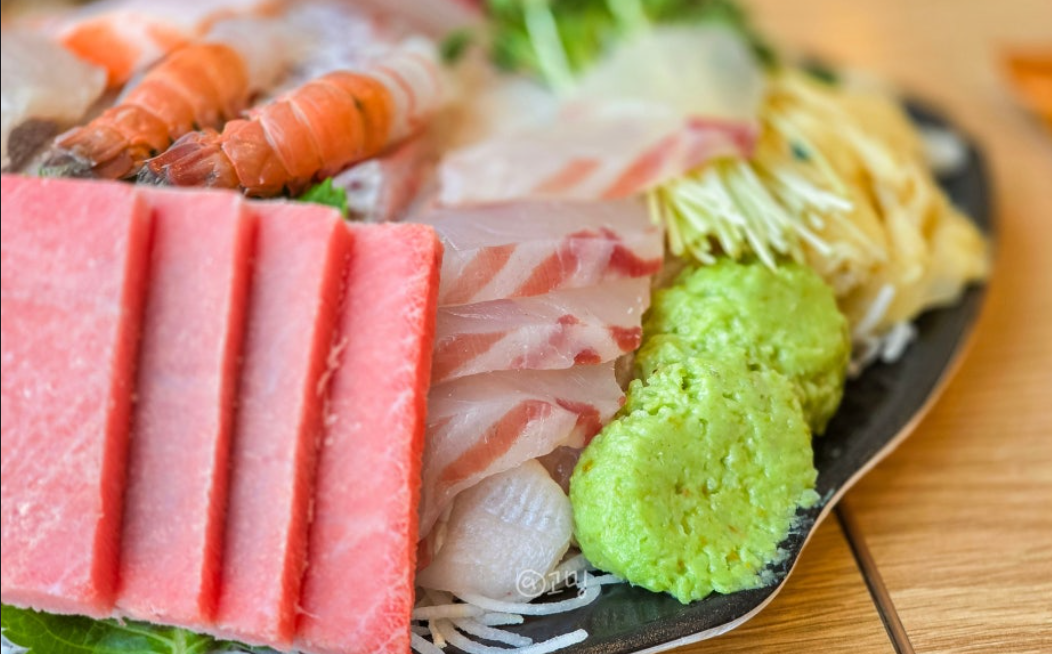
The composition of the omakase changes with the season, but a March visit will typically include something close to the following. Each piece is thick-cut — noticeably more generous than restaurant portions — and arrives lightly aged (살짝 숙성), which firms the flesh slightly and concentrates the gamchilmat [umami, savoury depth] without compromising freshness.
딱새우회 — Ttakssaeu-hoe [Spot prawn sashimi]
This is the opener, and it sets the tone immediately. Ttakssaeu [spot prawns] are not common at most Seoul restaurants — they’re more often associated with Jeju Island or the southern coast. Finding them here, sweet and firm and barely translucent, is a small surprise. The texture is tight and slightly springy, and the natural sweetness of the prawn needs nothing added. Think of it as the palate cleanser that makes everything that follows taste sharper.
줄무늬전갱이회 — Julmuneui Jeonjaengi-hoe [Striped jack mackerel sashimi]
March is peak season for jeonjaengi [jack mackerel] in Korean waters, and Cheongyang’s version makes a compelling case for eating fish exactly when you should. The flesh is pale and clean, with a gentle sweetness that deepens toward the skin side and a faint, almost grassy savouriness on the finish. Stripped of context, this would be a remarkable piece of sashimi anywhere; eaten here, at the market, while the fish is still hours-fresh, it’s exceptional.
도다리회 — Dodari-hoe [Flounder sashimi]
Dodari [flounder] is the other March headliner, and the saying “봄 도다리, 가을 전어” — “spring flounder, autumn gizzard shad” — is one of Korea’s most repeated seasonal food expressions. The meat is delicate, white, and carries a subtle sweetness that becomes more pronounced the thicker it’s cut. Here it’s generous. The chew is clean, the flavour lingers.
참돔회 — Chamdom-hoe [Red sea bream sashimi]
Chamdom [red sea bream] is one of the most prized white fish in Korean and Japanese seafood culture alike. Cheongyang’s version is cut thick enough to require a proper bite, which is exactly right — the thinly-sliced chamdom you sometimes encounter at lesser places loses too much of the texture in the eating. Here, it arrives with enough body to melt slowly on the tongue. This is the plate that prompts most people to reach for the sushi rice (provided alongside the platter) and make chobap [hand-pressed nigiri] — a DIY process that the staff encourage and set you up for with a generous portion of seasoned rice.
감성돔회 — Gamseongdom-hoe [Black sea bream sashimi]
The skin on these pieces has been lightly scored with a knife — a technique that allows the flavour of the skin to bleed into the flesh without leaving the skin itself chewy or unpleasant. Gamseongdom has a richer, more assertive flavour than the white fish preceding it, and it pairs particularly well with ssamjang [fermented soybean paste with sesame and garlic], which brings out a savoury, almost mineral quality in the fish. One of the more satisfying bites on the plate.
광어지느러미 — Gwangeo Jineureomi [Flatfish fin]
The jineureomi [fin section] of gwangeo [flatfish] is the cut that regulars quietly compete for. The meat around the fin is exercised more than the main fillet — it’s used constantly as the fish swims — which makes it denser, chewier, and more intensely flavoured. It’s the wagyu chuck of the flatfish world: not the most visually impressive piece on the plate, but the one that rewards the most attention. It’s the cut that makes soju [Korean distilled spirit] feel mandatory.
참치 — Chamchi [Tuna]
The tuna rounds out the plate on a note that feels almost carnivorous. The slice at Cheongyang is lightly marbled — enough fat to give it a silky, yielding quality without the heaviness of full toro [fatty tuna belly]. Several regulars compare eating it to well-rested wagyu beef: the fat isn’t rich so much as it is smooth, and the flavour lingers warmly after each bite. It’s an unusual way to close a sashimi course, but it works.
Practical Notes
Cheongyang Seafood (청양수산)
| Address | Noryangjin Fish Market 1F, Stall 40 — 674 Nodeul-ro, Dongjak-gu, Seoul |
| Phone | 010-8979-7618 |
| Hours | 24 hours, 365 days |
| Omakase price | From ₩85,000 (small / 소짜리) |
| Getting there | Subway Line 1 or 9 → Noryangjin Station, Exit 9 → 5 min walk past car park |
| Location in market | Near South Gate 1 (남1문), innermost section of the live fish floor |
| Ordering app | 인어교주해적단 |
Reserve ahead. This is not a walk-in situation for an omakase course — the vendor needs time to select and prepare the fish to order. Call the day before, or at minimum a few hours in advance.
Eat upstairs for maximum freshness. The market has a chojang [seasoned sauce] floor above the fish stalls where vendors let you bring your freshly-cut fish and eat it on the spot. Tables, chojang [red pepper vinegar dipping sauce], wasabi, ganjang [soy sauce], and kkae [sesame] are provided. There is usually a small per-person seating fee, which is standard practice across the market. Eating within minutes of the fish being cut is the point of coming here, and this is the way to do it properly.
Takeaway and picnics work too. Cheongyang will package everything neatly, and Noryangjin’s proximity to Yeouido — one of Seoul’s most popular outdoor leisure areas — makes it an unusually good option for a picnic. Pick up in the morning, head to the Han River park, eat within an hour. It’s a more enjoyable way to spend a spring morning than most restaurants can offer.
March seasonality. In early spring, expect gangdodari [flathead flounder] and jeonjaengi [jack mackerel] to feature prominently. Bangeoh [yellowtail/amberjack] is at the tail end of its season and may still appear. The omakase will always reflect whatever is genuinely in peak condition that week — which is the point.
Exploring Seoul’s food scene further? See our Seoul restaurant guide for fine dining, or our Korean street food guide for market eating.
There is something unusually honest about eating this way. No tasting menu theatre, no explanatory cards, no wine pairings — just a vendor who knows fish, a tank full of animals that were caught days ago, and a knife. The food is as good as it is because nothing is wasted on presentation or branding; all the effort goes into the sourcing and the cut.
Seoul has no shortage of expensive ways to eat well. Noryangjin’s omakase at Cheongyang Seafood is something rarer: an affordable way to eat at the very top of the supply chain, with a freshness that most high-end restaurants simply cannot match. If you eat raw fish and you’re in Seoul in the spring, this is where you go.