Korea has a gift for turning a global food moment into something entirely its own. When the Dubai Chocolate bar — that pistachio-and-kataifi-filled chocolate slab from the Emirati brand Fix Dessert Chocolatier — went viral worldwide in 2024, it was only a matter of time before Korean bakers, cafe owners, and food brands got their hands on the idea and ran with it.
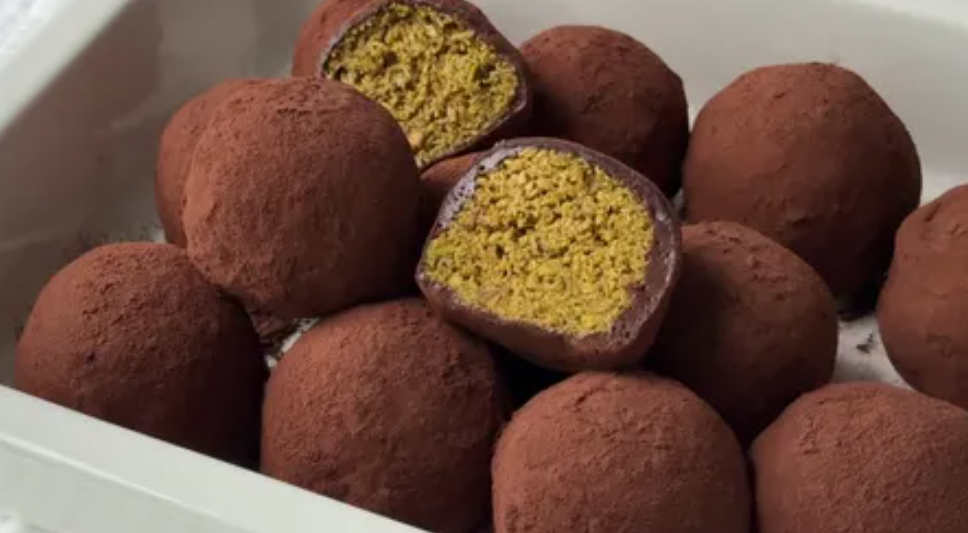
What emerged was the Dubai Chewy Cookie (두바이 쫀득 쿠키): a thick, dense, intensely chewy cookie packed with pistachio cream and strands of crispy kataifi pastry, often finished with a crackled chocolate coating. It’s the Dubai Chocolate concept reimagined for the Korean palate — and it’s everywhere.
Where It Came From
The original Dubai Chocolate bar (두바이 초콜릿) landed on Korean radar in mid-2024 via a wave of short-form videos showing people snapping open a chocolate bar to reveal a gooey, nutty, fibre-like interior. The visual was irresistible — the stretch of the pistachio filling, the crunch of the toasted kataifi threads — and it triggered a classic Korean food trend cycle: viral content, import demand, long queues, sold-out stock, and then local reinterpretation.
Korean bakeries and dessert cafes had already been experimenting with pistachio in various forms (pistachio lattes, pistachio croissants, pistachio rice cakes), so the leap to a Dubai-inspired cookie wasn’t difficult. The chewy cookie (쫀득 쿠키) format — already popular in Korea for its satisfying, mochi-adjacent texture — turned out to be a near-perfect vessel for the filling. The result combined two trend arcs at once, and the category exploded.
By early 2025, the Dubai Chewy Cookie had spread from independent dessert cafes in Hongdae and Seongsu-dong to convenience stores, franchise bakeries, and department food halls nationwide.
What It Tastes Like
The Dubai Chewy Cookie is a study in contrasts — and that’s precisely why it works.
The cookie base is dense and fudgy, somewhere between a brownie and a thick chewy cookie. It has almost no crunch to it; instead, it gives under pressure and pulls apart in slow, satisfying strips. Some versions use a cocoa-based dough, others go plain or butter-forward. Either way, the texture is the point: 쫀득하다 (jjondeuk-hada, the Korean word for this specific kind of chewy elasticity) is the quality every recipe chases.
Inside sits a filling of pistachio cream — typically a blend of pistachio paste and tahini or white chocolate — with toasted kataifi (kadayif, the shredded wheat pastry used in Middle Eastern desserts) stirred through it. The kataifi provides the crunch that the cookie itself deliberately lacks. It’s nutty, slightly savoury from the tahini, and rich without being cloying.
The exterior is often finished with a thin chocolate shell — dark or white — that adds a faint snap to the first bite before yielding to the chewy interior. Some versions dust the top with crushed pistachio or a flake of fleur de sel for visual contrast.
The overall effect is layered and complex for what is ostensibly a cookie: chewy, creamy, crunchy, nutty, and just sweet enough.
The Trend in Korea
The spread of the Dubai Chewy Cookie in Korea followed a pattern that food industry observers here know well.
Phase 1 — Specialty cafes. The first Korean versions appeared in independent dessert shops in late 2024, priced between ₩5,500 and ₩8,000 per cookie. Cafes in Seongsu-dong and Hongdae — areas known for early adoption of food trends — began offering limited daily quantities, which predictably led to queues and sold-out notices by noon.
Phase 2 — Social media saturation. Short-form videos of the cookie being pulled apart — revealing the green pistachio filling and golden kataifi strands — spread rapidly on Instagram Reels and TikTok. The format mirrors what made the original Dubai Chocolate bar go viral: high visual payoff in under ten seconds. Korean food influencers (먹방 creators and cafe reviewers) drove significant engagement, and the hashtag #두바이쫀득쿠키 accumulated hundreds of thousands of posts through 2025.
Phase 3 — Mass market entry. By mid-2025, CU and GS25 had both launched convenience store versions at around ₩3,500, making the trend accessible without the cafe queue. Paris Baguette and Tous les Jours followed with their own interpretations. Department store food halls — particularly those at Lotte and Shinsegae — introduced premium versions from specialty brands at ₩9,000 and above.
Phase 4 — Variation and iteration. As with any Korean food trend that reaches mass market, differentiation began quickly. Matcha-pistachio variations, strawberry cream versions, and oversized giant Dubai cookies (400g+, designed for sharing and for visual impact in short-form content) all appeared in the second half of 2025.
Public Response
Korean consumer reaction has been enthusiastic, if not entirely uncritical.
The dominant sentiment, captured across review platforms like Naver Map and Kakao Map as well as on community forums like Everytime and TheQoo, is that the cookie delivers on its premise: the texture is distinctive, the pistachio filling is more interesting than standard cookie fillings, and the visual appeal is genuine. Many reviewers single out the kataifi crunch as the element that elevates the cookie from trend food to something worth returning to.
The criticism tends to cluster around two points. The first is sweetness: convenience store versions in particular have been flagged as overly sweet, with the pistachio cream tipping into candy territory rather than the savoury-nutty balance that specialty versions achieve. The second is value: at ₩6,000–₩8,000 per cookie in cafes, some consumers feel the price runs ahead of the product, especially as the novelty fades.
There’s also the broader conversation — common to most Dubai Chocolate-derived products in Korea — about whether the kataifi used in domestic versions is authentic or approximate. Sourcing the real thing remains difficult and expensive, and some cafes substitute vermicelli-style noodles or processed grain alternatives, which affects both texture and flavour. Serious dessert enthusiasts tend to be vocal about the difference.
On balance, the response has been more sustained than the typical Korean food trend. Many fads peak within two to three months; the Dubai Chewy Cookie has maintained visibility well beyond that, likely because the format genuinely suits the Korean preference for chewy textures (쫀득) and because the pistachio flavour profile, once niche, has become broadly accepted.
Where to Try One
Specialty cafe versions remain the best expression of the cookie. Look for shops that source pistachio paste directly and use genuine kataifi — menus and social posts often specify this if it’s a selling point. Independent dessert cafes in Seongsu-dong, Mangwon-dong, and Yeonnam-dong in Seoul tend to have the most considered versions.
For convenience without the commute, CU’s own-brand Dubai Chewy Cookie is a reasonable entry point — better than most convenience store desserts, if not quite a match for the cafe original.
If you’re visiting a department store food hall, the rotating specialty stalls on basement food floors (B1 or B2 at most Lotte and Shinsegae branches) frequently stock limited-run versions from smaller producers. Arriving early on weekdays gives the best chance of finding stock before sellout.
For context on Seoul’s indie cafe neighbourhoods like Seongsu-dong, see our K-beauty shopping guide which covers the same area.
The Dubai Chewy Cookie is, at heart, a very Korean response to a global food moment: take the idea, improve the texture, localise the flavour balance, scale it across every retail channel, and iterate rapidly. Whether it has the staying power of, say, the dalgona or the egg tart remains to be seen. For now, it’s one of the more genuinely satisfying food trends to arrive in recent memory — chewy, nutty, and exactly as good as the videos suggest.