When BTS took the stage in front of Gwanghwamun Square for a free outdoor concert — drawing tens of thousands of fans into the streets below one of Seoul’s oldest surviving structures — the image said something that no tourism campaign could have scripted: Korea’s most iconic historical gate as the backdrop for one of the world’s biggest acts. If you saw that concert footage and wondered where exactly they were standing, this is the place.
Gwanghwamun doesn’t ask much of you as a visitor. An hour is enough to walk the gate, cross the square, and get some sense of what you’re looking at. But it’s the kind of place that stays with you longer than the time you spent there — because everything you see has been destroyed and rebuilt, and the story of that destruction and reconstruction tells you something fundamental about Korea that a museum exhibit can’t quite replicate.
A Brief History
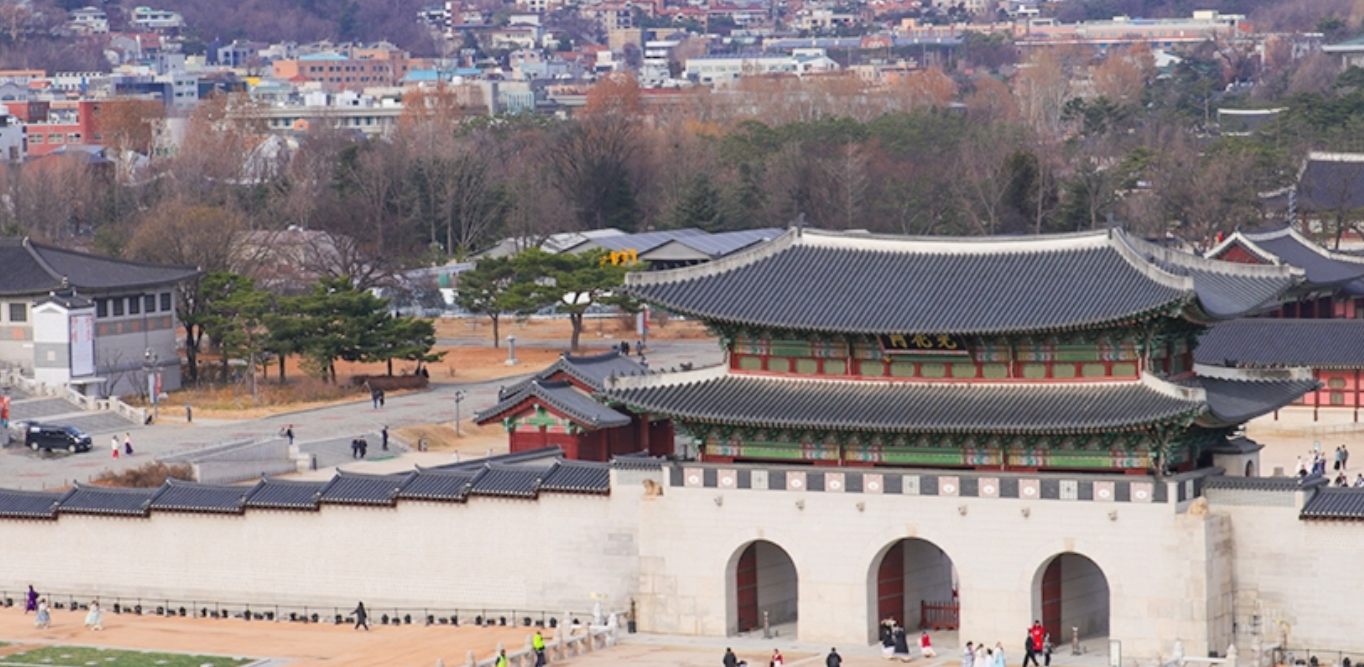
The gate was first built in 1395, three years after King Taejo founded the Joseon dynasty and established Hanyang (present-day Seoul) as his new capital. Gyeongbokgung Palace — the largest of Seoul’s five grand palaces — was laid out according to geomantic principles, positioned between the mountain Bugaksan to the north and a clear southern view across the Han River plain. Gwanghwamun stood at the palace’s southern face as its principal ceremonial gate: the point through which officials entered on formal occasions, where royal proclamations were read, and where the axis of the capital formally began.
The gate’s name, 광화문 (Gwanghwamun), translates roughly as “the gate where the light of civilisation spreads in all four directions” — a deliberate declaration of Joseon’s political and cultural ambitions.
It has been destroyed twice.
The first time was in 1592, when Japanese forces under Toyotomi Hideyoshi invaded Korea and burned much of the palace complex during the Imjin War. The gate and palace remained in ruins for nearly 270 years before being painstakingly rebuilt in 1867 under the regency of Heungseon Daewongun — a reconstruction that was itself a political statement about restoring Joseon authority.
The second destruction came during Japanese colonial rule. In 1926, Japanese administrators relocated the gate 14.5 metres to the east to make way for the new Government-General Building — a deliberate act of symbolic displacement, situating the colonial administration between the Korean king’s gate and his palace. During the Korean War, air bombardment in the early 1950s reduced the gate to rubble. A concrete replica was erected in 1968, in the wrong position and on a slight angle, but the intention to restore the original site was always there.
The full restoration came in 2010. Using photographs, old survey records, and original construction documents that had survived in archives, architects rebuilt the gate on its correct historical alignment in traditional wooden construction. The painted dancheong colours — the deep reds, blues, and greens of the bracketing and eaves — were restored based on pigment analysis of surviving fragments. It is the most accurate version of Gwanghwamun that has stood in over a century.
The Square
Directly in front of the gate, Gwanghwamun Square (광화문광장) underwent a major renovation and reopened in August 2022. The redesign expanded the pedestrian area significantly, reclaimed space from the six-lane road that had bisected the original square, and added a large underground exhibition hall, a reflecting pool, and improved landscaping.
Two statues anchor the square’s civic identity:
Admiral Yi Sun-sin (이순신 장군) stands at the southern end, sword raised. Yi is the Korean naval commander who repelled Hideyoshi’s invasion fleet in the 1590s — including the famous Battle of Myeongnyang, where 13 turtle ships defeated a Japanese fleet of 133. He is arguably the most revered figure in Korean history.
King Sejong the Great (세종대왕) sits at the northern end, closer to the gate. Sejong created Hangul, the Korean alphabet, in 1443 — an act of deliberate democratisation, designed to replace classical Chinese characters with a script that ordinary Koreans could learn in days rather than years. Below the statue, an underground exhibition hall (Sejong Story) covers his scientific, cultural, and administrative achievements in detail. It’s free, air-conditioned, and a good option if the weather isn’t cooperating above ground.
The view from the square looking north — with the gate framed by Bugaksan Mountain behind it — is one of the most photographed compositions in Seoul. The alignment is intentional and centuries old.
The BTS Concert
In recent years, Gwanghwamun Square has become a venue for major live events, and no event illustrated its power quite like BTS’s free outdoor concert held in front of the gate. The group performed to tens of thousands of fans packed into the square and the surrounding streets, with the floodlit gate visible behind the stage — a backdrop that compressed six centuries of Korean history into a single frame.
For many international visitors, that image was their first real introduction to Gwanghwamun. For Koreans watching, there was something fitting about it: a square that has been the site of royal ceremonies, pro-democracy protests, World Cup street parties, and candlelight vigils was now the stage for a K-pop act that had become one of the most successful cultural exports in the country’s history.
The square has since hosted subsequent large-scale concerts and public performances. If you’re visiting during a festival period or major K-pop anniversary, check whether an outdoor event is scheduled — the scale of a performance in this particular location is hard to replicate elsewhere.
What to Do Here
The Changing of the Royal Guard (수문장 교대의식) takes place at the gate’s entrance daily at 10:00 and 14:00, weather permitting (closed Mondays and in heavy rain). The ceremony, performed by guards in full Joseon military dress, lasts around 20 minutes. A re-enactment of the full ceremonial procession happens on weekends. It’s genuinely well-staged and worth timing your arrival around.
Walk through the gate and into Gyeongbokgung Palace. Gwanghwamun is the entrance to the palace grounds, and the palace itself is a full half-day. If you only have an hour at Gwanghwamun, walk through the gate to see Heungnyemun (the second gate) and get a sense of the palace’s scale, then come back another time for the full visit. The two together — palace plus Gwanghwamun — pair naturally with the National Folk Museum of Korea which sits inside the palace grounds and is free.
The Seoul Museum of History is a five-minute walk west of the gate and has a section of the original Gwanghwamun stonework preserved outside its entrance — an odd and moving thing to see alongside the restored gate. The museum itself is worth visiting if you want to understand how the city around the gate was built, destroyed, and rebuilt.
The Sejong Story underground exhibition below King Sejong’s statue is free and covers Hangul’s creation and Joseon’s scientific achievements (water clocks, celestial globes, the invention of metal movable type) with decent English throughout.
Practical Details
- Address: Gwanghwamun Gate, Sajik-ro, Jongno-gu — Gwanghwamun Station, Line 5, Exit 2 (the gate is visible immediately)
- Hours: The gate itself is always visible. The guardhouse area opens with the palace grounds: daily 09:00–18:00 (Mar–Oct to 18:30; extended summer and winter hours vary). Closed Tuesdays.
- Admission: The square and gate exterior are free. Gyeongbokgung Palace entry is ₩3,000 (adults).
- Guard ceremony: Daily at 10:00 and 14:00 (except Mondays and inclement weather). Full weekend procession at 10:00 and 14:00.
- Best time to visit: Late afternoon for the light on the gate and mountain. Early morning (before 09:30) for the square without crowds. Cherry blossom season (late March–mid-April) is beautiful and extremely busy.
- Nearest food and coffee: The Sejong Cultural Centre and surrounding streets have cafés. For something more significant, Bukchon Hanok Village is a 15-minute walk northeast through the Anguk area.
Gwanghwamun is not a hidden find — it’s one of the first things most visitors to Seoul encounter. That familiarity can make it easy to walk past too quickly. Don’t. The gate stood here for six centuries, was destroyed twice, and was rebuilt with a care for historical accuracy that reflects something about how Koreans think about their past. An hour spent understanding what you’re looking at converts a photo stop into something that frames the rest of your time in the city.